
ECG vs 2D Echo: What’s the Difference & When Do You Need Them?
Imagine this: you feel occasional chest discomfort or palpitations. You visit a doctor—and they suggest either an ECG or a 2D Echo.
But which one do you actually need?
Most patients are confused because both tests are related to heart health—but they serve very different purposes.
Let’s simplify it.
First, Understand This: Your Heart Has Two Stories
Think of your heart in two ways:
- Electrical system → how your heart beats
- Mechanical system → how your heart pumps
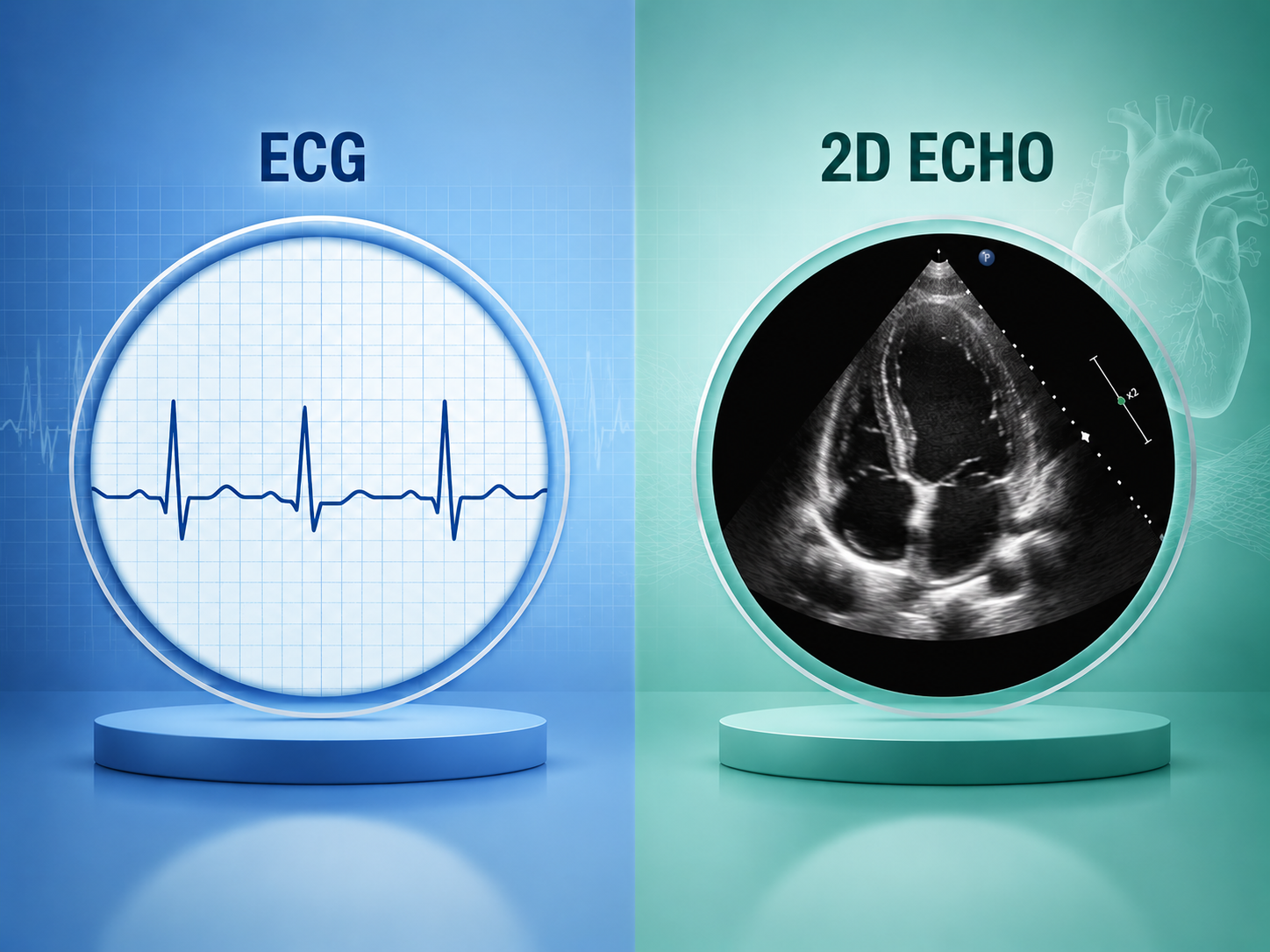
👉 An ECG checks the electrical activity
👉 A 2D Echo checks the structure and pumping function
⚡ What Is an ECG?
An Electrocardiogram records the electrical signals of your heart.
What It Detects:
- Irregular heartbeat (arrhythmia)
- Heart attack (current or past)
- Abnormal heart rhythm
- Conduction problems
Time Taken:
5–10 minutes
Best For:
Quick screening and emergency evaluation
🫀 What Is a 2D Echo?
Echocardiography uses ultrasound waves to create live images of your heart.
What It Shows:
- Heart structure (valves, chambers)
- Pumping strength (ejection fraction)
- Blood flow patterns
- Valve diseases
Time Taken:
15–30 minutes
Best For:
Detailed heart function analysis
⚖️ ECG vs 2D Echo — Quick Decision Guide
| Situation | Best Test |
|---|---|
| Sudden chest pain | ECG |
| Palpitations | ECG |
| Suspected heart attack | ECG |
| Breathlessness | 2D Echo |
| Heart valve problem | 2D Echo |
| Weak heart pumping | 2D Echo |
👉 In many cases, doctors recommend both tests together for accurate diagnosis.
🔍 Real-Life Scenarios (Helps You Decide Faster)
📌 Scenario 1: You feel sudden chest pain.
👉 Start with ECG to rule out emergency conditions.
📌 Scenario 2: You feel long-term breathlessness or fatigue.
👉 Go for 2D Echo to assess heart function.
📌 Scenario 3: You have an irregular heartbeat.
👉 ECG detects rhythm issues instantly.
📌 Scenario 4: You have a history of heart disease.
👉 2D Echo monitors heart structure and pumping.
🚨 When Should You Not Delay Testing?
Seek immediate evaluation if you have:
- Chest pain
- Shortness of breath
- Dizziness or fainting
- Rapid heartbeat
These could be signs of a heart attack or other serious conditions.
🧪 Can One Test Replace the Other?
No.
👉 ECG and 2D Echo are complementary tests, not substitutes.
- ECG = electrical signals
- 2D Echo = structure & function
Using both gives a complete picture of your heart health.
🏥 Which Test Will Your Doctor Recommend?
That depends on your symptoms.
An experienced specialist like Dr. Vikas Purohit, known as a best cardiologist and trusted heart specialist Jaipur, will decide based on:
- Symptoms
- Medical history
- Risk factors
🧠 Pro Tip: Don’t Self-Diagnose
Many patients search online and directly go for tests—but this can lead to:
- Wrong test selection
- Delayed diagnosis
- Unnecessary expenses
👉 Always consult a cardiologist first.
💬 What Most Patients Ask (Quick Answers)
- “ECG normal hai, toh heart problem nahi hai?” → Not always
- “2D Echo kar liya, ECG zaroori hai?” → Sometimes yes
- “Kaunsa test better hai?” → Depends on your symptoms

👨⚕️ Expert Insight
According to Dr. Vikas Purohit:
👉 “ECG and 2D Echo are both essential tools. The right test at the right time can prevent major heart complications.”
📌 Final Takeaway (Simple Rule)
- Sudden symptoms → ECG first
- Ongoing symptoms → 2D Echo
- Confused? → Consult a cardiologist
❓ FAQs
1. What is the main difference between ECG and 2D Echo?
ECG records electrical activity of the heart, while 2D Echo shows the structure and pumping function.
2. Which test is better for chest pain?
ECG is usually the first test for chest pain as it detects heart attack quickly.
3. Can ECG detect heart blockage?
ECG may indicate blockage indirectly, but further tests like 2D Echo or angiography are needed.
4. Is 2D Echo painful?
No, it is a painless and non-invasive ultrasound test.
5. Who is the best cardiologist in Jaipur for heart tests?
Consult Dr. Vikas Purohit, an experienced heart specialist Jaipur.